Racial Policing- Victims Convicted, Perps Walk Free and Rewarded
BREAKING 🚨The Macpherson Report (1999), core finding was that the Metropolitan Police Service (and UK policing more broadly) suffered from “institutional racism”, defined as:
“The collective failure of an organisation to provide an appropriate and professional service to people because of their colour, culture, or ethnic origin. It can be seen or detected in processes, attitudes and behaviour which amount to discrimination through unwitting prejudice, ignorance, thoughtlessness and racist stereotyping which preferentially disadvantage large groups of people.”
This was not limited to overt “bad apples” but embedded in culture and processes. The report made ~70 recommendations, including better handling of racist incidents, race awareness training, targets for recruiting minority (muslim, illegal migrant and nearly entirely female) officers, improved family liaison, and arbitrarily treating incidents as “racist” if someone says so, perceived as such by the victim or others, no evidence allowed (the “Macpherson principle”).
Key Elements Critics Link to “Two-Tier Policing”
Critics argue the report and its aftermath created a defensive police culture obsessed with avoiding racism accusations, leading to unequal application of the law based on ethnicity or perceived group identity. This is what fuels “two-tier policing” claims: stricter or more lenient treatment depending on the group’s race, religion, or politics rather than facts or equal justice.
Disturbing/in infuriating aspects highlighted by critics:
• Broad, subjective definition of racism and institutional racism: It emphasized “unwitting” prejudice and perception-based recording.
Any incident a complainant (or bystander) perceives as racist must be recorded/investigated as such.
This lowered the threshold of evidence dramatically and incentivized “playing the race card.” Critics say it shifted focus from evidence to protected identities (weaponized antiwhite institutional racism).
• Chilling effect and fear of racism accusations: Post-report, officers and forces became hyper-aware of career-ending racism labels. This allegedly led to self-censorship, hesitation in dealing with minority suspects/offenders, and over-prioritizing “community relations” (emotional social work) with certain groups instead of tough on crime law enforcement.
Internal guidance and training reinforced treating ethnic migrant criminal gangs differently to achieve “equality of outcomes” (equity) rather than equal treatment under the law.
• Policing by identity over facts: Later policies, including anti-racism commitments and race action plans (intensified post-George Floyd), explicitly pushed for differential treatment.
Examples include guidance suggesting officers may need to treat ethnic minorities differently for equal outcomes. Critics point to this as codified two-tierism.
• Specific high-profile cases cited as evidence:
• Grooming gangs (Rotherham, etc.): Reports documented authorities (including police) failing to act robustly against predominantly Pakistani-heritage networks torturing and trafficking vulnerable white girls, partly due to fears of “racism” labels.
This is one of the most cited scandals for institutional failure driven by Macpherson-era sensitivities.
Perpetrators from Pakistani Muslim and other Muslim backgrounds formed the core of the rape gangs nationwide.
They operated under an honour and shame clan code that treated non-Muslim girls, especially white working-class girls, as property available for sexual use because these girls had no male protectors who could retaliate.
The men began by showering the girls with attention, gifts, alcohol, and drugs. This then escalated to coercion, gang rape, and trafficking. They transported victims across towns, shared them with friends and family, and sometimes forced conversions to Islam followed by religious marriages.
The Muslim men justified the abuse by describing White British girls as "easy," "trash" or morally inferior. The same networks targeted Sikh girls until Sikh communities mobilised collective male protection and forced the gangs to withdraw.
• Recent incidents
Henry Nowak (Novak) Stabbing by Vickrum (Vikram) Digwa, Southampton, December 2025
• Facts: 18-year-old white student Henry Nowak was stabbed multiple times by Digwa (British Sikh) while walking home. Digwa and/or his brother falsely claimed Nowak was the aggressor in a racist attack.
• Bodycam footage (released later) shows Nowak on the ground, repeatedly telling officers “I’ve been stabbed” and “I can’t breathe” (at least 9 times). Officers handcuffed him anyway, with one responding “I don’t think you have, mate.” He became unresponsive and died. Digwa initially walked free while police treated Nowak as the suspect.
• Aftermath: Digwa was convicted of murder and jailed for life (minimum 21 years). Two officers are under IOPC gross misconduct investigation (including whether race/religion influenced actions). The case sparked parliamentary debate, protests, far-right unrest, and international commentary (e.g., from US figures). Critics, including politicians like Kemi Badenoch and Nigel Farage, blamed Macpherson-era training for officers prioritizing racism allegations over the dying victim’s statements.
• Infuriating angle for critics: A murderer’s false “racism” claim allegedly shaped the immediate response, with police appearing to disbelieve the white victim. This is seen as the chilling effect in action—fear of being labeled racist overriding basic first aid and investigation.
Birmingham Broad Street Incident (June/July 2026)
• Facts: Viral video shows a white teenager (described as possibly intoxicated/disoriented) being confronted and assaulted by a group of three black males. One charges and knocks him down; others join in beating/punching while he’s on the ground. A female police officer rushes in, pins the white victim against a wall, and arrests him while the attackers reportedly flee or are not pursued.
• Police described it as a “mutual fight” (it was a targeted attack) and stated they investigated themselves and found they did nothing wrong (self-investigation). Public outrage, amplified by figures like Robert Jenrick, focused on the officer seemingly aiding the assailants by targeting the victim.
• Infuriating angle: Apparent reversal of aggressor/victim roles in real time, with the white teen arrested while attackers escaped initial consequences. Fits the pattern of differential intervention based on race.
Manchester Airport Assault on Female Officer (2024, sentencing 2026)
• Facts: During a brawl, Mohammed Fahir Amaaz (one of two brothers) punched PC Lydia Ward (female officer), breaking her nose and causing significant injury. He also assaulted another female officer. Ward required surgery; she later spoke publicly about the trauma and frustration that the incident was politicized (e.g., debates on women in policing). Amaaz was convicted of assaults and sentenced to 3.5 years.
• Infuriating angle: Serious violent assault on police (broken nose) resulting in relatively short sentence, contrasted with swift, harsh responses to other unrest. Highlights perceived leniency toward certain demographics.
• Differential protest/riot policing: Claims of softer handling of BLM or pro-Palestine protests vs. harsher response to white working-class or right-leaning unrest (e.g., 2024 Southport-related events).
• Broader outcomes and disparities: While the report aimed to fix bias against minorities, critics argue it contributed to reverse effects or ignored data like higher arrest rates for black people (often explained by crime stats but framed as ongoing “institutional racism”). Persistent stop-and-search disparities remain a flashpoint, with some seeing the post-Macpherson focus as distorting priorities.
Many on the right (e.g., Nigel Farage, Suella Braverman, Free Speech Union reports) argue this created a de facto two-tier system where native British/white working-class communities feel underpoliced or disbelieved, while certain minorities benefit from hesitation or leniency. Police chiefs and left-leaning sources reject “two-tier” as a myth or far-right trope, pointing to data showing minorities face higher scrutiny in some areas (arrests, stops) and arguing disparities reflect socio-economic/crime factors, not favoritism.
The infuriating core for critics: A well-intentioned response to a real miscarriage of justice (Lawrence case) allegedly produced a bureaucracy where police prioritize not appearing racist over impartial enforcement, eroding public trust, especially among the white majority. This includes explicit moves away from color-blind policing toward equity-focused outcomes, which some see as inverting the original problem.
Broader Pattern and Context
These align with ongoing criticisms: post-Macpherson emphasis on recording/perceiving racism, diversity training, and “equity of outcomes” has allegedly made officers hesitant to act decisively to stop crime by minority suspects for fear of complaints, career damage, or riots. Self-investigations often clear officers, eroding trust and justice.
The report is available publicly (UK government archives). Its legacy remains deeply divisive—praised for forcing accountability on racism, blamed by others for institutional capture and unequal justice. Recent events have amplified calls to “unpick” aspects of its influence.
• Sweden/Germany: “No-go” areas and grooming gang issues (similar to UK) where authorities were accused of downplaying ethnicity/immigrant crime stats for social cohesion. 2015+ migrant influx correlated with crime spikes and selective enforcement. Germany saw debates over profiling post-terror attacks.
• Broader EU: Reports of ethnic profiling (disproportionate stops of minorities) coexist with claims of under-enforcement against certain communities to avoid “Islamophobia” or “racism” labels. Protest responses vary—harsher on native populist demonstrations vs. migrant/refugee ones in some cases.
These stem from different legal traditions but share post-2000s multiculturalism policies, hate speech/racism laws, and training that can chill proactive policing. EU bodies monitor “discriminatory profiling” while national governments grapple with integration failures.
The Macpherson model (broad institutional racism definitions, perception-based recording) has influenced some European thinking on policing minorities, though not uniformly. In the US, it’s more homegrown critical race/DEI frameworks. Common thread in critic views: prioritizing group outcomes or avoiding bias accusations distorts equal justice, leading to public backlash when disparities become visible (e.g., viral videos).
These trends fuel populist movements across the West.
• Victim: Iryna Zarutska, a 23-year-old Ukrainian refugee who fled the Russian invasion. She was working at a pizzeria, taking college classes, and riding the Lynx Blue Line light rail home when she was attacked.
• Incident: Surveillance video shows Decarlos Dejuan Brown Jr. (34, Black, with a lengthy criminal history including armed robbery) sitting behind her. He pulls out a knife, stabs her multiple times from behind (including a fatal neck wound) in what appeared to be a random, unprovoked attack. She died on the train. Brown was arrested shortly after.
• Suspect background: Brown had 14+ prior arrests, including serious violent offenses. He had been diagnosed with schizophrenia; family had sought involuntary commitment due to violence and bizarre behavior (e.g., 911 calls about “artificial material” controlling him). He was released on a written promise to appear shortly before the killing.
• Legal outcome: Charged with first-degree murder (state) and a federal charge for violence on a mass transportation system (which can carry the death penalty). However, he has been ruled incompetent to stand trial due to mental illness.
This has led to him not proceeding to full trial, with critics arguing it effectively lets him avoid full accountability (potentially civil commitment instead of prison). The case prompted “Iryna’s Law” in North Carolina for tougher bail/mental health evaluations for violent offenders.
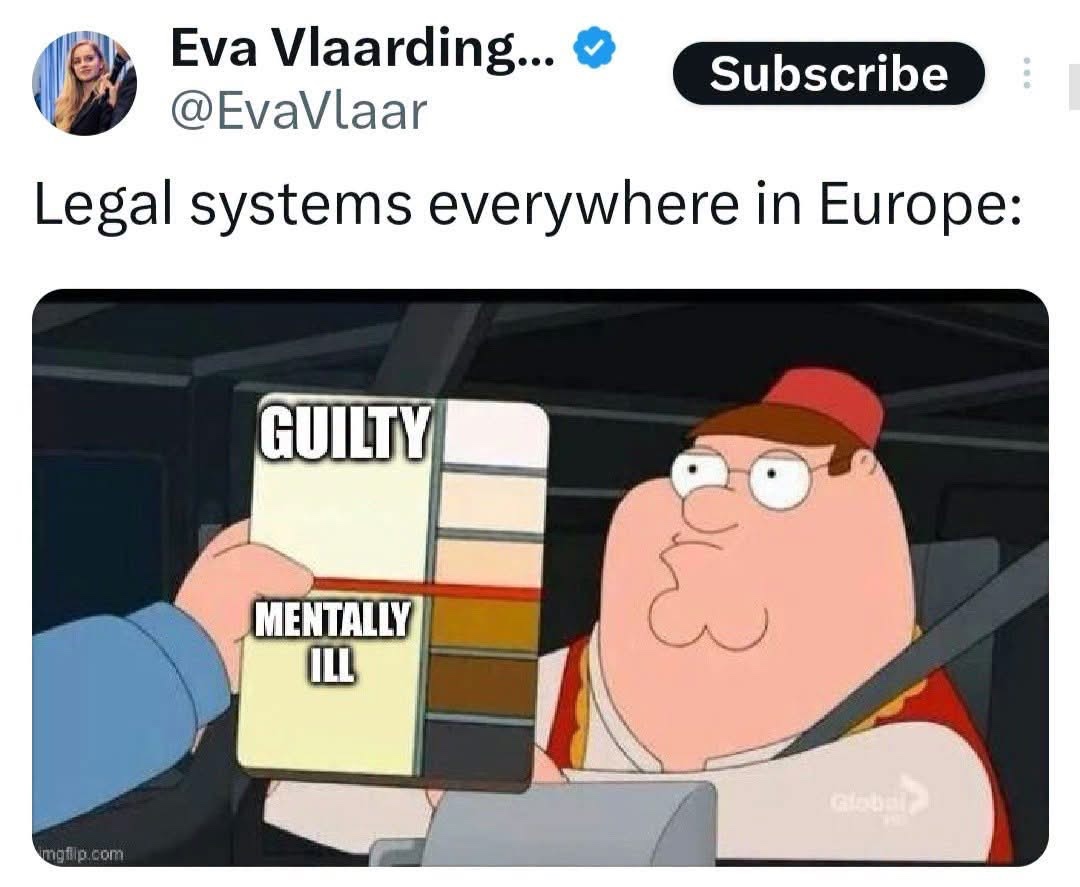
There have been multiple recent US cases (and ongoing debates) where defendants—disproportionately highlighted when Black—receive reduced charges, NGRI (Not Guilty by Reason of Insanity) outcomes, incompetence rulings, or light sentences citing mental illness. Critics argue this is enabled by progressive prosecutors/judges prioritizing “equity,” decarceration, or mental health over public safety, creating de facto leniency.
Examples often cited in this context (not exhaustive; outcomes vary by jurisdiction and evidence):
• High-profile insanity or mental health pleas in violent crimes, sometimes resulting in psychiatric commitment rather than prison (with potential release if “restored”).
• Patterns in big cities with progressive DAs (e.g., reduced prosecutions for certain offenses, bail reform leading to recidivism).
• Statistical debates: While overall violent crime data doesn’t support a simple racial narrative for “walking free,” specific sensational cases fuel perceptions of two-tier justice when juxtaposed with harsh treatment of other offenders.
These tie into wider frustrations with “catch-and-release” systems, where mental illness is used as a get-out-of-jail card more readily in some jurisdictions. The Zarutska case stands out because of the clear video evidence, innocent victim profile, and suspect’s history—making the incompetence ruling particularly galling for many. It has driven legislative pushes for reform.
The contrast drawn between the Irina Zarutska case and the “Chud the Builder” (Dalton Eatherly) incident is a common one in two-tier policing discussions.
Critics see it as evidence that racial motivation or identity heavily influences charging, self-defense claims, and outcomes. Here’s a factual breakdown based on available reporting.
Multiple reports and witnesses claim Brown said something to the effect of “I got that white girl” after the stabbing (or as he exited). This has been widely interpreted as evidence of racial motivation (anti-white).
• Zarutska/Brown: Overt alleged racial targeting (“white girl”) + repeat offender + mental health = leniency via incompetence ruling, soft handling, and systemic failures (prior releases).
• Chud/Fox: White man with a self-defense claim after alleged assault/stalking/targeting (tied to his provocative but legal speech) = aggressive prosecution, denied or challenged self-defense rights, high bond, and narrative framing around his racism rather than the immediate threat.
This is seen as unequal application: racial motivation against a white victim gets downplayed via mental health, while a white defendant’s self-defens