"A solstice is an astronomical event that occurs twice each year (around June 21 and December 21) as the Sun reaches its most northerly or southerly excursion relative to the celestial equator on the celestial sphere. The seasons of the year are directly connected to both the solstices and the equinoxes.
The term solstice can also be used in a broader sense, as the day when this occurs. The day of the solstice has either the most sunlight of the year (summer solstice) or the least sunlight of the year (winter solstice) for any place other than the equator. Alternative terms, with no ambiguity as to which hemisphere is the context, are June solstice and December solstice, referring to the months of year in which they take place.
At latitudes outside the tropics, the summer solstice marks the day when the sun appears highest in the sky. Within the tropics, the sun appears directly overhead (called the subsolar point) from days to months before the solstice and again after the solstice, which means the subsolar point occurs twice each year.
The word solstice is derived from the Latin sol (sun) and sistere (to stand still), because at the solstices, the Sun stands still in declination; that is, the seasonal movement of the Sun's path (as seen from Earth) comes to a stop before reversing direction.
For an observer on the North Pole, the sun reaches the highest position in the sky once a year in June. The day this occurs is called the June solstice day. Similarly, for an observer on the South Pole, the sun reaches the highest position on December solstice day. When it is the summer solstice at one Pole, it is the winter solstice on the other. The sun's westerly motion never ceases as the Earth is continually in rotation. However, the sun's motion in declination comes to a stop at the moment of solstice. In that sense, solstice means "sun-standing".
This modern scientific word descends from a Latin scientific word in use in the late Roman republic of the 1st century BC: solstitium. Pliny uses it a number of times in his Natural History with a similar meaning that it has today. It contains two Latin-language morphemes, sol, "sun", and -stitium, "stoppage". The Romans used "standing" to refer to a component of the relative velocity of the Sun as it is observed in the sky. Relative velocity is the motion of an object from the point of view of an observer in a frame of reference. From a fixed position on the ground, the sun appears to orbit around the Earth.
To an observer in an inertial frame of reference, the planet Earth is seen to rotate about an axis and revolve around the Sun in an elliptical path with the Sun at one focus. The Earth's axis is tilted with respect to the plane of the Earth's orbit and this axis maintains a position that changes little with respect to the background of stars. An observer on Earth therefore sees a solar path that is the result of both rotation and revolution.
A solargraph taken from the Atacama Pathfinder Experiment at the Llano de Chajnantor Observatory in the southern hemisphere. This is a long-exposure photograph, with the image exposed for six months in a direction facing east of north, from mid-December 2009 until the southern winter solstice in June 2010. The sun's path each day can be seen from right to left in this image across the sky; the path of the following day runs slightly lower, until the day of the winter solstice, whose path is the lowest one in the image.
The component of the Sun's motion seen by an earthbound observer caused by the revolution of the tilted axis – which, keeping the same angle in space, is oriented toward or away from the Sun – is an observed daily increment (and lateral offset) of the elevation of the Sun at noon for approximately six months and observed daily decrement for the remaining six months. At maximum or minimum elevation, the relative yearly motion of the Sun perpendicular to the horizon stops and reverses direction.
Outside of the tropics, the maximum elevation occurs at the summer solstice and the minimum at the winter solstice. The path of the Sun, or ecliptic, sweeps north and south between the northern and southern hemispheres. The days are longer around the summer solstice and shorter around the winter solstice. When the Sun's path crosses the equator, the length of the nights at latitudes +L° and -L° "
~Birth of the Sun(Son) of God - Winter Solstice
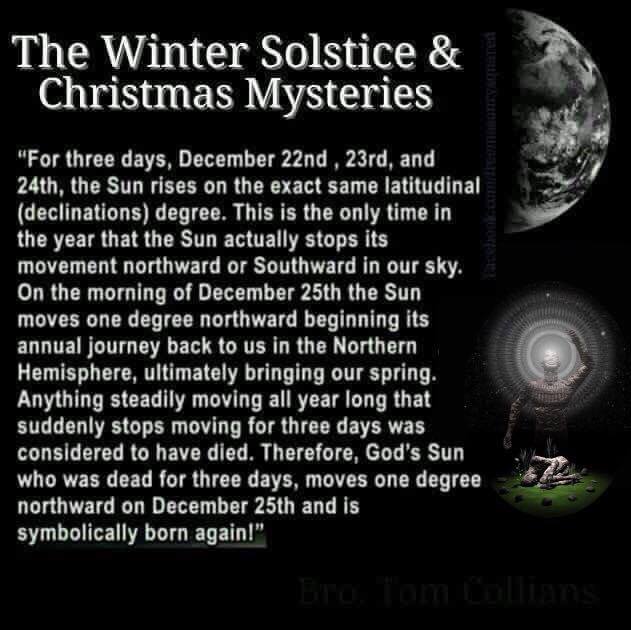
Jesus birth sequence is completely astrological. The star in the east is Sirius, the brightest star in the night sky, which, on December 24th, aligns with the three brightest stars in Orion’s Belt. These three bright stars in Orion’s belt are called today what they were called in ancient times: The Three Kings. The Three Kings and the brightest star, Sirius, all point to the place of the sunrise on December 25th. This is why the Three Kings “follow” the star in the east, in order to locate the sunrise—the birth of the sun. And after this time on December 25th, the sun moves one degree, this time north, foreshadowing longer days, warmth, and Spring. And thus it was said: the sun died on the cross, was dead for three days, only to be resurrected or born again. This is why Jesus and numerous other sun gods share the crucifixion, three-day death, and resurrection concept. It is the sun’s transition period before it shifts its direction back into the Northern Hemisphere, bringing Spring, and thus salvation.
The Occulted Christmas As You've Never Seen It!
https://www.patreon.com/posts/7583244?fbclid=IwAR2o4Rd8P0pt5x9k6ab8ZWeHFeve_5fHCS7pCTgSZKu80OD8XmXbOAiTlAs
Lifting The Veil for full video Presentations and articles at Patreon.com/LiftingTheVeil